
A job candidate has every reason to be charming to the executive holding the offer. They listen closely, laugh at the right moments and make sure their best qualities are visible. The interaction is real, but the incentive is impossible to ignore.
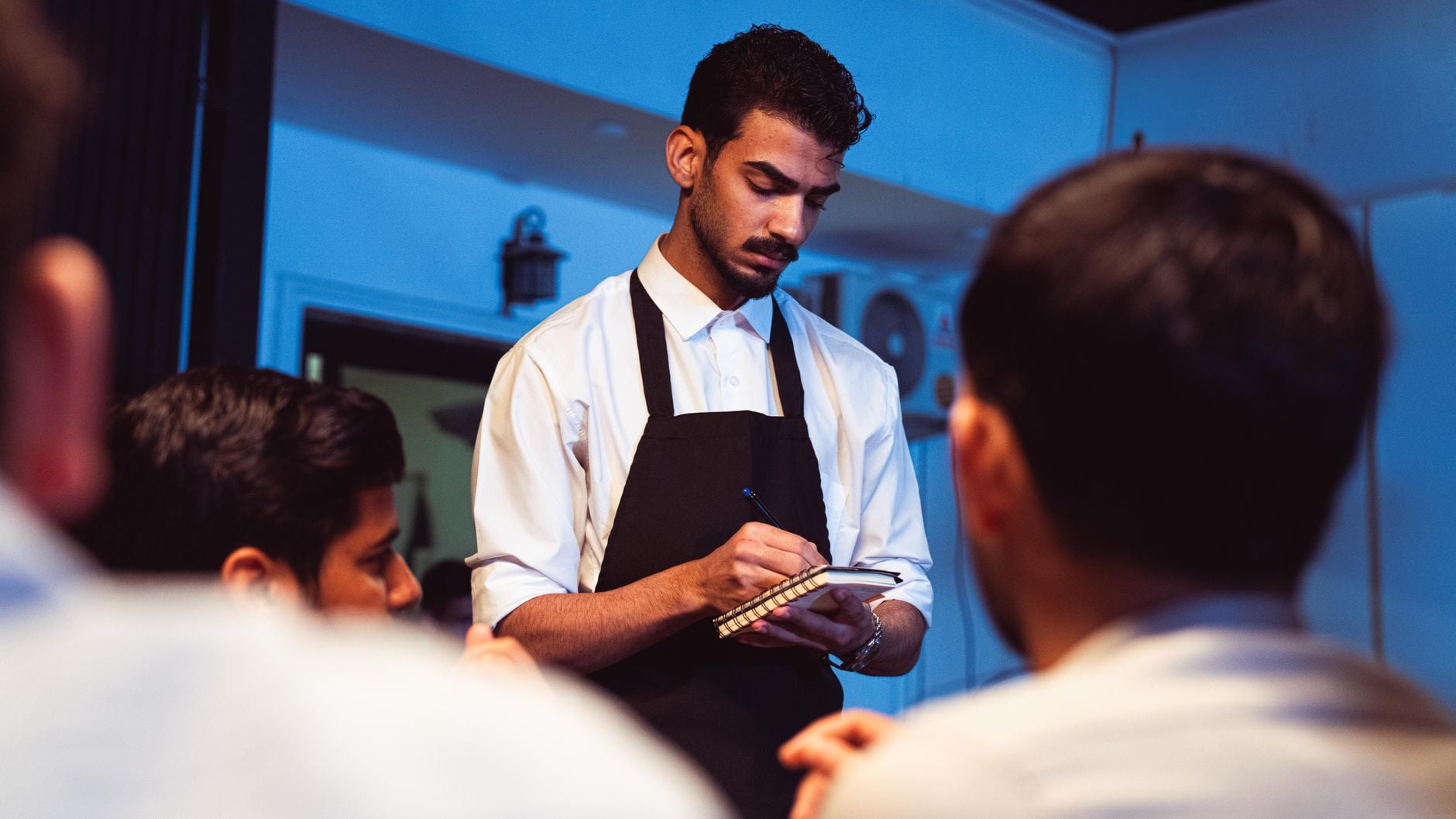
The Waiter Rule changes the direction of observation. At lunch, how does the candidate speak to the person taking the order? Do they acknowledge them, ask rather than command, and respond to a mistake without turning someone with less power into a target?
Executives adopted the rule because it seemed to distinguish courtesy as a principle from courtesy as a strategy. The intuition is useful, but the mythology runs ahead of the evidence. Rudeness to service staff can be a serious red flag. Politeness during one staged meal is not a validated certificate of character.
A 2006 newspaper story made the rule famous
The phrase entered corporate folklore through a 2006 USA Today article by Del Jones. Jones interviewed about a dozen chief executives and found unusual agreement around the idea that treatment of service workers revealed something treatment of a boss could not.
Office Depot CEO Steve Odland recalled working in a Denver restaurant as a teenager. After he spilled purple sorbet on a customer’s expensive white dress, she recovered her composure, reassured him and left without humiliating him. Decades later, he still treated her response as a lesson in character.
Panera Bread co-founder Ron Shaich said he had used treatment of a server in a hiring decision. BMW North America president Tom Purves thought the principle travelled across cultures. The article’s central figure, Raytheon CEO Bill Swanson, included the maxim in a booklet of management rules that Raytheon distributed on a huge scale.
The origin story contains a revealing irony
Swanson’s booklet said, “A person who is nice to you but rude to the waiter, or to others, is not a nice person.” He described a dinner in the 1970s when a companion became obnoxious because a restaurant did not carry a particular wine. The behaviour suggested what Swanson called a situational value system, with charm switched on or off according to another person’s status.
But Swanson did not invent the core line. It closely resembled a maxim in humorist Dave Barry’s 1998 book Dave Barry Turns 50. Other parts of the Raytheon booklet echoed a 1944 engineering text and additional sources without proper credit.
Within weeks of the Waiter Rule article, the booklet itself became a corporate ethics story. Raytheon stopped distribution. The Washington Post reported that more than 300,000 copies had been produced and that the company froze Swanson’s salary and reduced his restricted-stock award after he apologised for failing to credit other authors.
The irony does not make the Waiter Rule false. It does make the history more instructive. A memorable principle can be valuable even when the executive who popularised it is himself being judged for whether public conduct and private standards match.
Why behaviour across a power gap feels diagnostic
The rule works by changing the incentive structure. A candidate depends on the hiring executive, so upward politeness is rewarded. A restaurant server is expected to remain professional and has little influence over the candidate’s career. Courtesy directed downward is therefore more voluntary, while hostility is less risky for the person displaying it.
Psychology offers a plausible reason power differences might matter. In four experiments and a correlational study published in 2006, Adam Galinsky and colleagues found that people placed in higher-power states were less inclined to adopt another person’s visual perspective, more likely to assume others shared their privileged knowledge and less accurate at reading emotional expressions.
The finding does not say every powerful person becomes inconsiderate. It suggests that power can make attention more self-anchored when nothing pushes it outward. A restaurant interaction may reveal whether someone actively corrects for that pull or comfortably treats a lower-power person as part of the scenery.
Research on social class has sometimes found a related pattern. A 2010 Psychological Science paper reported across three studies that lower-class participants read others’ emotions more accurately, with greater attention to social context offered as an explanation. That work helps explain why dependence on other people might sharpen social attention.
The evidence does not validate one-meal mind reading
None of those studies tested the Waiter Rule as a hiring tool. They do not establish that a restaurant observation predicts leadership, ethics or later treatment of employees. The rule remains a folk heuristic supported by executive anecdotes and adjacent social-psychology findings.
Its information is also asymmetric. Open contempt, threats, snapping fingers or deliberate humiliation are difficult to reconcile with respectful leadership. A single harsh episode can reveal a boundary someone is willing to cross. Pleasant behaviour proves far less, because a candidate who knows the rule can perform kindness for the duration of lunch.
Context creates other hazards. Someone may be anxious, distracted, exhausted, culturally unfamiliar with local service conventions or responding clumsily to a genuine problem. Observers can mistake a flat tone, limited eye contact, disability or linguistic difference for arrogance. Their judgement may also absorb stereotypes about class, race, gender and accent.
Even the broader status-and-empathy literature is mixed. A 2018 investigation using more than 10,000 participants found that earlier inverse links between social class and emotion perception generalised poorly across larger, more diverse samples and different measures. Some results were null, while others ran in the opposite direction. Social rank is not a personality scanner.
Hiring science favours structure over intuition
The Waiter Rule invites a global conclusion from a vivid moment. That is exactly where interviews can go wrong. Once an interviewer decides a candidate is gracious or entitled, confirmation bias can make every later detail look like evidence for the same story. A warm exchange produces a halo; one awkward sentence produces a horn.
More defensible selection begins with a job analysis, asks candidates the same job-relevant questions, scores answers against behaviourally anchored criteria and combines ratings from multiple trained assessors. A 2022 reanalysis of personnel-selection research found that many older validity estimates had been inflated by statistical overcorrection, yet structured interviews still emerged as the top-ranked selection procedure.
That does not mean human observations should be discarded. It means they should be collected consistently. If treatment of lower-power colleagues matters to the role, define the behaviour in advance. Ask every candidate for examples of responding to a junior employee’s mistake, sharing credit, receiving service failure or handling disagreement without positional force.
Feedback from receptionists, coordinators and other staff can add evidence, but candidates should face comparable touchpoints and raters should record specific behaviour rather than impressions such as “not our kind of person.” The difference is between documenting conduct and converting taste into a hidden test.
The best version of the rule looks for a pattern
A hiring team can use the Waiter Rule as a prompt: does this person’s respect change with the status of the person in front of them? The answer should come from multiple settings, not one lunch. References can be asked how the candidate treated assistants, contractors, interns and colleagues who could not advance their career.
The same principle applies outside restaurants. Watch what happens when a driver is late, a receptionist needs information repeated, a technician cannot fix something immediately or a junior colleague challenges an assumption. The diagnostic feature is not perfect manners. It is whether frustration becomes permission to diminish someone.
Silicon Canals has explored this idea from another angle: behaviour that stays consistent when the other person has nothing to offer is more meaningful than the performance of status. That consistency is what the Waiter Rule is really trying to notice.
The rule survives because it captures a genuine asymmetry. Politeness aimed upward has an obvious reward. Respect aimed downward often does not. When those two versions of a person sharply diverge, the contradiction deserves attention.
But a window is not the whole house, and one restaurant interaction is not a soul. Use obvious disrespect as a reason to investigate, then rely on structured evidence, repeated behaviour and references before deciding who someone is or whether they should lead.