

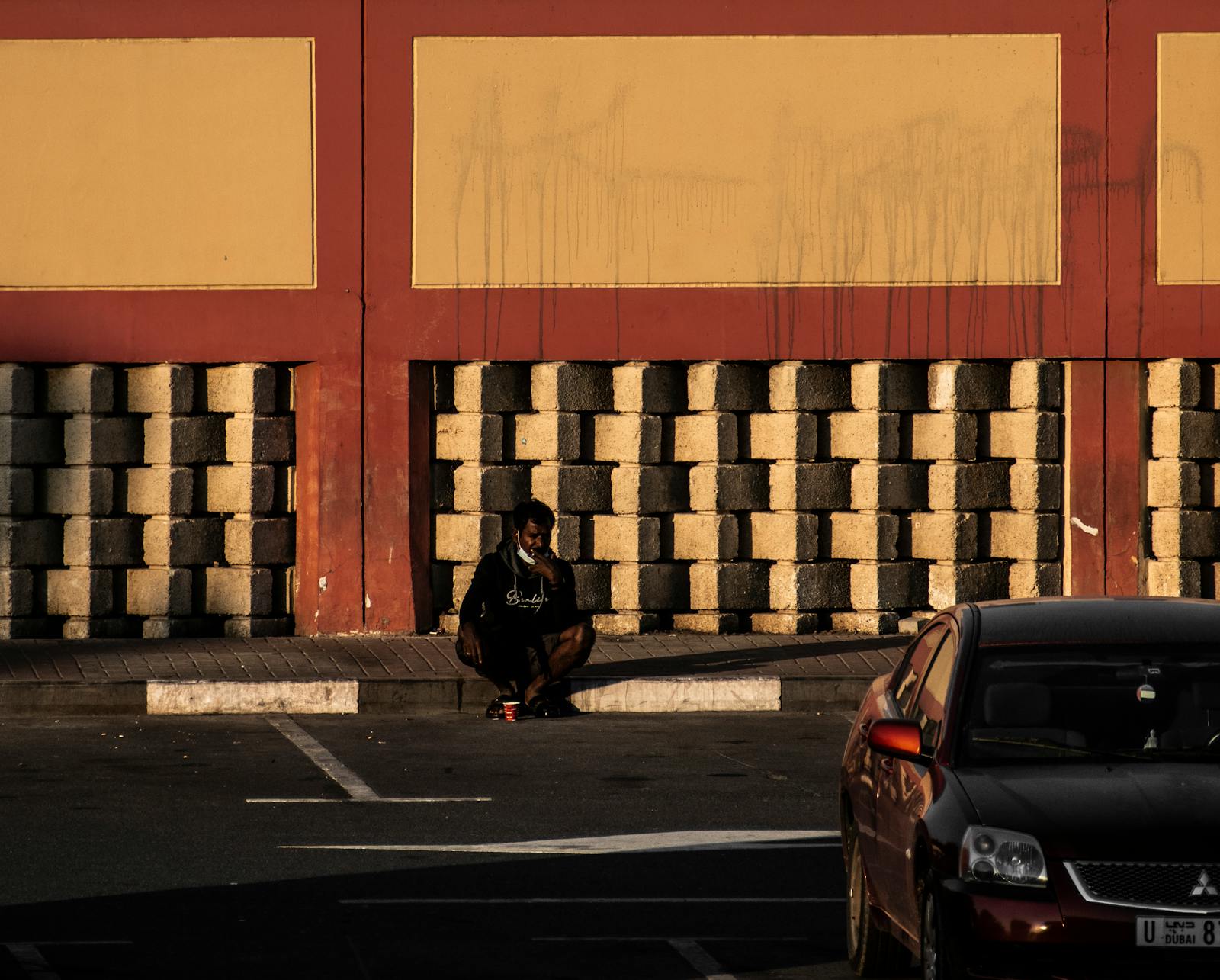
The conventional read on someone who sits in their car for ten minutes after pulling into the driveway is that they’re stalling. Avoiding the spouse, avoiding the kids, avoiding whatever waits behind the front door.
Sometimes that is true. But often, something quieter is happening. The person in the parked car is not trying to disappear from the household. They are claiming the only small block of the day that nobody else has a visible claim on.
For people whose lives are built around being needed, home is not always where rest begins. Home can be where the next shift starts.
The car, by accident of geography, becomes the only neutral room.
The geography of unowed time
Think about how a typical day is structured for someone with a job, a partner, children, ageing parents, or any combination of these. Work hours belong to the employer. Commute hours belong to traffic, messages, podcasts, and mental rehearsal of what comes next. Evening hours belong to whoever needs feeding, listening to, reminding, driving, comforting, or helping with homework. Sleep belongs to recovery from all of it.
Where, in that map, is the time that belongs to no one?
For a lot of people, the answer is a parked car. A bathroom with the door locked. A slightly extended trip to take out the bins. An extra lap around the block before pulling into the driveway.
These are not always avoidance behaviours. Often, they are micro-territories of sovereignty carved out of a day that has otherwise been claimed in full.
The hand-off between roles, employee at 5:47, parent at 5:58, is not automatic. It requires a buffer. Without one, the irritation of a meeting that ran late can land on whoever happens to be standing in the kitchen.
Why a small pocket of solitude can feel so restorative
A 2024 study from Oregon State University, published in PLOS One, surveyed nearly 900 adults about their experiences of being alone. The study, led by Morgan Quinn Ross with Scott Campbell, looked at different “shades” of solitude, from more complete isolation to looser forms of alone time that still allow access to people or media.
The finding was useful because it complicates the usual fantasy of rest. Complete withdrawal was not always the most restorative version. According to the Oregon State summary, less complete forms of solitude, such as reading in a café or listening to music while commuting, were more likely to restore energy and maintain a sense of connection than more intense solitude.
That does not prove that every driveway pause is healthy, or that sitting in a car is a universal cure for a hard day. It does suggest something more modest and more useful: solitude does not always need to look dramatic to matter. It can be shaded. It can be ordinary. It can happen with a phone nearby, the house in view, and the rest of life only a few steps away.
The car has that kind of accessibility built in. Someone could knock on the window. The phone is right there. The person has not left town. They are not unreachable. They are simply between demands.
The difference between solitude and avoidance
From the outside, solitude and avoidance can look almost identical. The car is parked. The engine is off. The person is not coming in.
The difference is in the direction of the feeling.
Avoidance is dread of what comes next. Solitude is reluctance to give up what is happening right now. Avoidance says, “I cannot face them.” Solitude says, “I need a few more minutes before I become available again.”
A Psychology Today essay on solitude describes intentional alone time as different from loneliness and notes that solitude can support autonomy, emotional steadiness, and a sense of inner peace. That is useful context, but the everyday version is simpler than any formal language makes it sound.
The person in the driveway is rarely rejecting the people inside. More often, they are reluctant to surrender the only stretch of the day where nothing is being asked of them.
Why this hits harder for certain people
Not everyone needs a parking-lot pause. Some people walk straight from the car to the kitchen and feel fine. Others would feel their whole body tighten at the thought of doing that.
The difference is not temperament. It is workload. People in caregiving roles, parents of young children, nurses, teachers, social workers, customer-facing workers, managers, and anyone whose job is essentially being available to other humans may need a longer buffer. So can people whose home life is also high-demand. If both ends of the day involve being needed, the only quiet space may be the transition between them.
There is a pattern here that overlaps with something Silicon Canals has covered before: the pressure of always being reachable. People who learned early that being unavailable would be treated as a personal failure can build lives where every visible hour is accounted for. The parking lot becomes one of the few places left where no one expects them to pick up, answer, soothe, fix, decide, or perform.
The role of control in a stressful day
A person’s sense of control over ordinary hassles can shape how stressful those hassles feel. A 2025 Penn State study reported by ScienceDaily looked at more than 1,700 adults in the National Study of Daily Experiences and found that, on days when people felt more control over their stressors, they were more likely to take action to resolve them.
The study does not say that sitting in a car solves stress. It does point toward a familiar human truth: people cope better when they do not feel completely carried along by everyone else’s demands.
Ten minutes in a parked car is, on paper, an absurdly small intervention. It produces nothing. It accomplishes nothing. It would not show up in a productivity audit. That is precisely the point. It is time that resists the logic of accomplishment.
Most of the rest of the day cannot resist that logic. Work has deliverables. Parenting has dinners and bedtimes. Even leisure tends to get scheduled, tracked, and optimised. The car, sitting in a driveway with the engine cooling down, is one of the last unproductive spaces left.
What the family on the other side of the door often misreads
The partner watching from the kitchen window may interpret the pause as a problem. Why isn’t he coming in. Why is she just sitting there. Is something wrong. Is something wrong with us.
Usually nothing is wrong. The person in the car is not necessarily building up to a difficult conversation. They are not necessarily silently resenting the household. They may simply be running a small, private recovery ritual that allows them to come inside as a person rather than as a depleted function.
The five-minute version of this person, the one who skips the pause and walks straight in, may be shorter with the kids, less patient with the partner, more likely to snap at a question about dinner. The ten-minute version, the one who took the parking-lot break, may be the version everyone actually wants to meet at the door.
This is the irony that often gets missed. The pause is not always taken from the family. Sometimes it is taken for the family.
The other versions of the same behaviour
The parking-lot pause has cousins. The long shower. The slow walk back from the mailbox. The extra loop around the block before pulling in. The unnecessary trip to the petrol station on the way home. The five minutes spent sitting on the edge of the bed before getting up.
All of these can serve the same function. They are stolen seconds in a day that otherwise feels accounted for to the minute. They are how a person who has forgotten how to ask for rest manages to take some anyway.
There is a related pattern Silicon Canals has covered before, about people who keep their calendars full because empty time feels like an accusation. The parking-lot pause is the same impulse running in reverse. When the whole calendar is full, the only way to claim unstructured time is to take it from a transition that nobody is watching.
When the pause becomes a problem
To be fair, this behaviour can tip into something less harmless. If the pause stretches from ten minutes to forty. If the person finds themselves driving in circles because going home feels unbearable. If the feeling at the front door is not ordinary end-of-day depletion but consistent, specific dread, that deserves attention.
The Oregon State researchers made a related distinction about motivation. Solitude tended to feel better when people chose it because they had a positive attitude toward being alone and expected to reconnect later. It tended to feel worse when it came from a negative attitude toward social interaction, such as not wanting to deal with people at all.
That distinction is a helpful way to read the driveway pause. It is usually benign when it functions as a reset. It becomes more concerning when it functions as an exit ramp.
The wider point about autonomy
What makes this behaviour interesting is how much it reveals about the architecture of a person’s life. Anyone who has to manufacture solitude in a car may be signalling that the rest of the day does not contain much of it.
That is not a personal failing. It is a structural fact about modern adulthood, especially for people in caring roles, service work, demanding families, or jobs that reward constant availability.
Sitting in a car for ten minutes is, in that frame, not a quirky habit. It is a person performing a tiny act of self-governance in a day otherwise structured around everyone else’s needs.
What the pause is really saying
The kindest reading of the parking-lot pause is not that the person dislikes their home. It is that the day has left them with too little margin, and the car is where the margin has quietly reappeared.
It is worth sitting with the strangeness of that. A person’s own home — the place they pay for, share with the people they chose, return to every night — has become a space they need to gather themselves before entering. The commute used to absorb the shift from work-self to home-self. The walk from the train station used to do it. The smoke break, for those who took one, used to do it. The quiet kitchen before anyone else was awake used to do it. A bus ride, a cigarette outside an office, a slow elevator down twenty floors — each of these was a small architectural feature of the day that nobody had to defend or schedule. They were built into the shape of working life. Most of them have now been engineered away in the name of efficiency, hybrid work, or simply faster cars. What is left is a driver, a darkened dashboard, and a few minutes of borrowed quiet before the second job of the evening begins.
So the question worth asking is not why some people sit in their cars. It is why so many households have come to function as a second workplace — one that issues tasks the moment the door opens, and treats the threshold itself as a punch-in clock. If home is supposed to be the place where a person is restored, why does crossing into it so often require a private, unsanctioned act of preparation? A household that cannot tolerate a slow entry may be a household that has quietly stopped distinguishing between the people who live there and the labour they perform.
The parked car is not the problem. It is the receipt.
Feature image by aboodi vesakaran on Pexels