

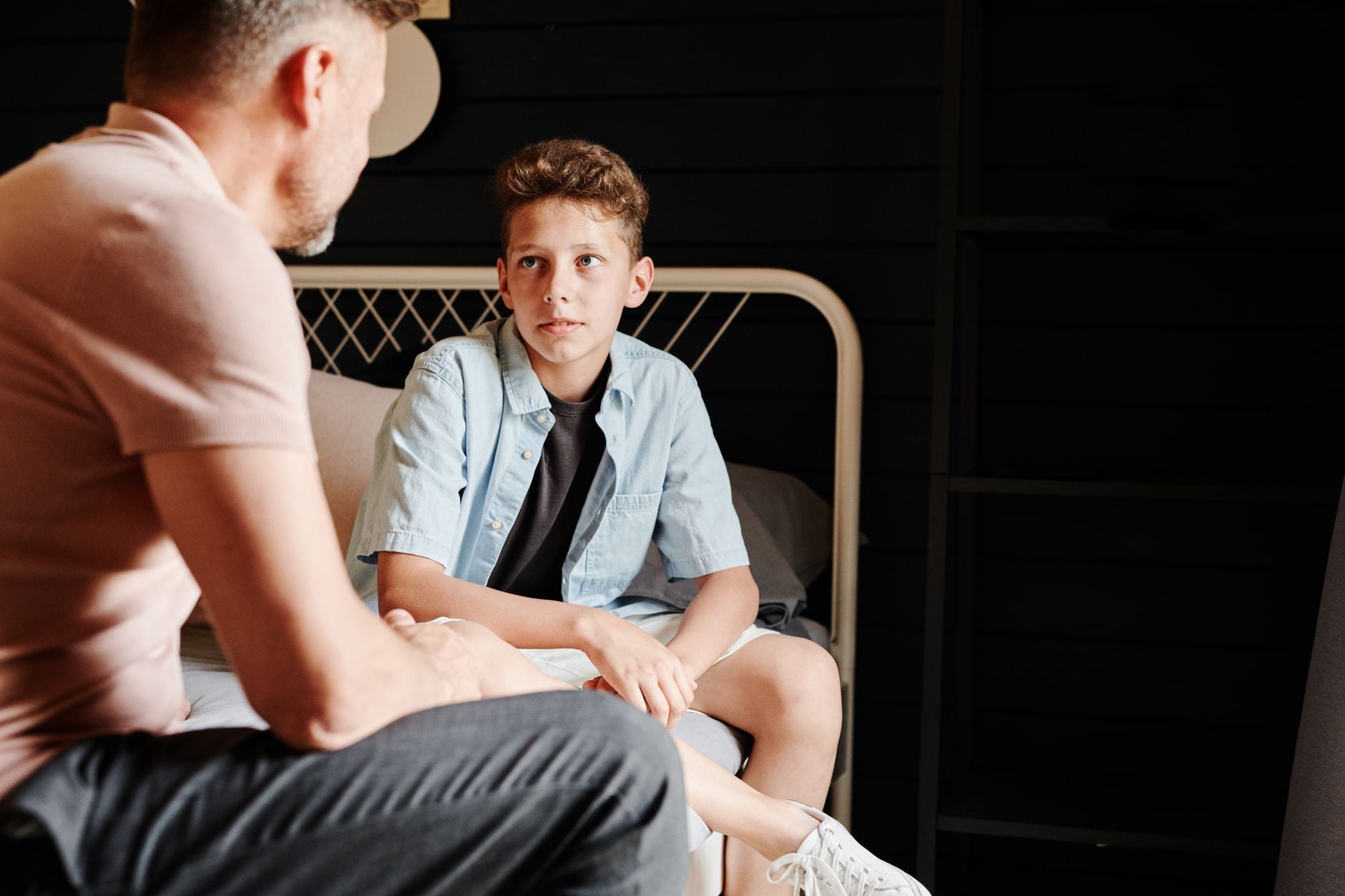
The format is warm and familiar: children of good-hearted parents grow into adults who are this, that and the other. As a broad claim it more or less survives contact with the research, since warmth and kindness in parents genuinely do predict empathy, generosity and good adjustment in their grown children. But the interesting question, the one that turns a feel-good list into something useful, is how. And the mechanism, it turns out, is a good deal more specific and less magical than kindness simply rubbing off.
It is warmth plus reasoning, not warmth alone
The psychologist Martin Hoffman argued that empathy and conscience are cultivated by a particular parental habit. When a child misbehaves, a parent can respond with raw power, a smack or a flat “because I said so,” or with what Hoffman called induction: drawing the child’s attention to the effect of their behaviour on other people. Look how sad you made her. How would you feel if someone did that to you? It is the second move, repeated across a childhood, that he believed did the real work.
In 1996 the researchers Jean Krevans and John Gibbs tested the idea directly, and found the pattern Hoffman had predicted. Children whose parents leaned on inductive discipline rather than power assertion were more empathic, and the more empathic children were more prosocial, with empathy acting as the bridge between the parenting and the behaviour. The lesson is subtle and worth sitting with. Good-hearted parents seem to pass on kindness less by being sweet than by habitually turning the child’s gaze toward how others feel, over and over, until considering other people becomes something close to automatic. Warmth matters, but it is warmth harnessed to a running commentary on other minds that appears to do the heavy lifting.
How deep the transmission can run
The most striking evidence of how far this reaches comes from an extreme case. In the 1980s the sociologists Samuel and Pearl Oliner interviewed more than four hundred people who had risked their own lives to hide Jews in Nazi-occupied Europe, and compared them with bystanders from the same places and years who had not acted. The rescuers were not, by and large, saints marked out from birth. What distinguished them, in their own accounts, was their upbringing.
Far more than the bystanders, the rescuers remembered parents who modelled caring, who disciplined by explaining rather than by hitting, and who explicitly taught tolerance toward people unlike themselves. Those everyday lessons had become, in the Oliners’ description, ingrained and habitual, and decades later, under about the most extreme pressure a person can face, they surfaced as a reflex to help. It is a sobering demonstration that the qualities a good-hearted parent instils are not merely pleasant traits for a dinner party. In the right and terrible circumstances, they can become the difference between action and paralysis.
The qualities, honestly stated
So the list is not wrong. Grown children of warm, reasoning, values-modelling parents do tend, on average, toward the things the format promises: empathy, a habit of considering others, prosocial generosity, and sometimes a quiet moral steadiness that holds when it is tested. But the honest version differs from the listicle in two ways. It names the specific practice, warmth combined with reasoning about other people, rather than a vague aura of good-heartedness, and it insists on the phrase on average. These are tendencies spread across many people, not a script that any single life is bound to follow.
What the evidence does and does not settle
The limits matter here more than usual, because a claim like this can wound as easily as it flatters. It is probabilistic, not deterministic. Warm and thoughtful parents sometimes raise children who struggle, and difficult, even unkind, childhoods have produced some of the most compassionate adults alive, often precisely because they resolved to be different. The studies also cannot cleanly separate parenting from heredity and temperament, which run together in families, so some of what looks like transmitted kindness may be partly shared disposition. The Oliner findings rest on people’s memories of childhoods long past, which memory quietly reshapes. And “good-hearted” is carrying a great deal of undefined weight; the research is about particular things parents do, not a halo they either possess or lack.
None of this should be read as a verdict, on anyone’s parents or on anyone’s own worth. Children of good-hearted parents do tend to carry something forward, and the evidence even shows what and how, an empathy built one explained mistake at a time. But it is a tendency and an inheritance rather than a sentence, and the genuinely hopeful thing buried in the research is that the crucial ingredient, the habit of turning attention toward how others feel, is not sealed off in childhood. It is something any adult can begin practising, for a child or for themselves, at whatever point they decide to start.